
Voice-Directed Task Manager:
One Call. Six Tools. Aligned Action.
Team leaders waste hours chasing updates across dashboards and chat threads. Harmony eliminates that fragmentation by turning a single phone call into full-stack task coordination.
Speak naturally, your AI checks project data in Notion, interprets intent through Voiceflow, and routes follow-ups automatically via Slack and Gmail through n8n. Twilio powers the call, Voiceflow carries the conversation, and automation handles the rest.
No tabs. No typing. Just clarity and action.
https://github.com/Luke-McNeur/voice.directed.task.manager.git
How It Works
When you call your Harmony line, Twilio captures the conversation and passes it to a Voiceflow agent trained on your company’s project data.
The AI interprets what you’re asking — status update or new instruction — and sends that intent through n8n.
If you’re asking for a task update, n8n queries your Notion database and reads the result back into the same call.
If you’re assigning something new, n8n routes the instruction to the right Slack channel and logs a full record in Gmail.
Every interaction is timestamped, messaged, and stored automatically — so updates never get lost in DMs or emails.
Your team hears your direction once. The system handles the rest.
Tech Stack + Integration Map
Twilio – Captures and transcribes your voice call
Voiceflow – Interprets intent and maintains conversation flow
n8n – Routes logic between all connected services
Notion – Central source of project and task data
Slack – Delivers real-time task assignments and updates
Gmail – Generates automatic documentation and email trails
Prototype Data Source:
This live Notion table feeds directly into our n8n/Voiceflow prototype. Each row represents a project scenario used to test and showcase the system’s capabilities in real-time. Use the chat window to ask details about the data, such as “What is the status of the Bloom Events content approval?”
Workflow Engine
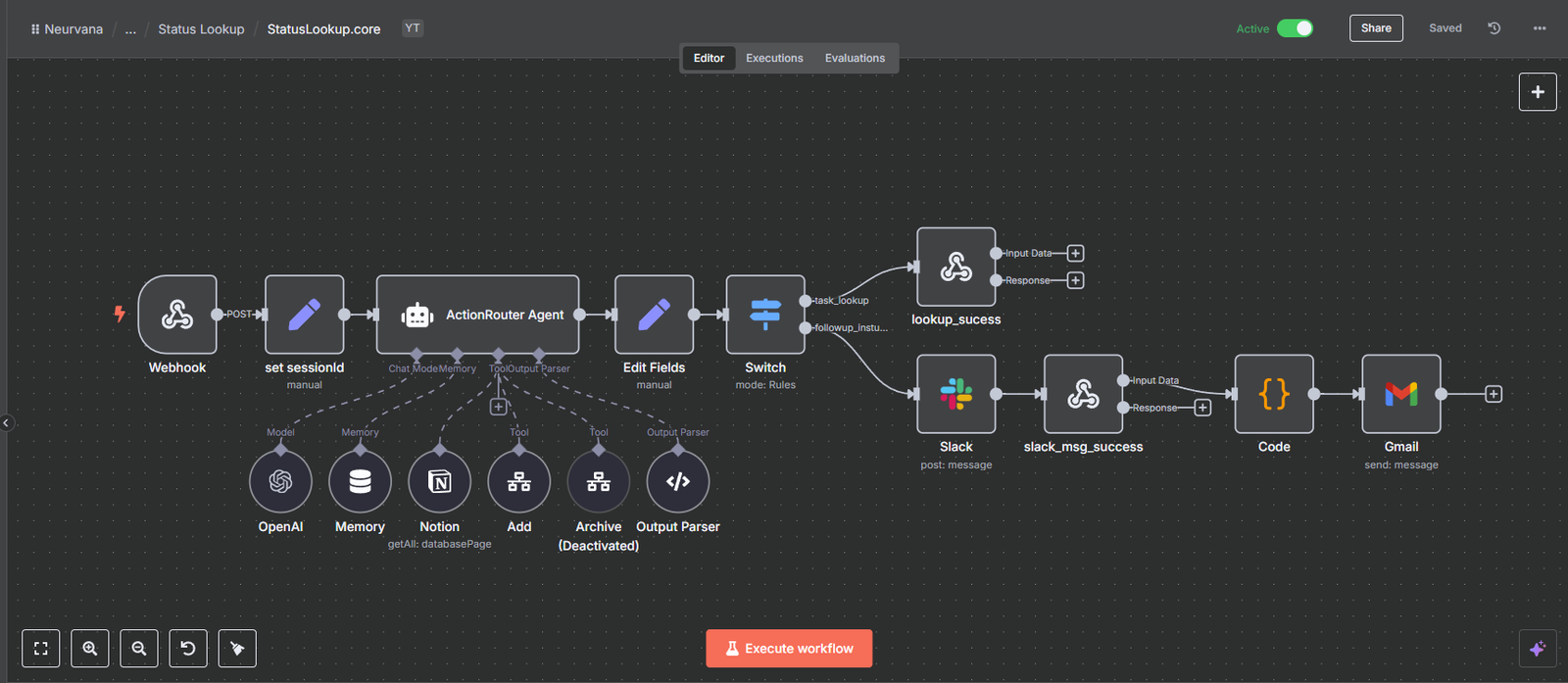
n8n operates as the intelligent core of the system, the automation layer that connects every tool and interprets your intent.
When you speak, it instantly queries your Notion workspace, formats the results, and determines whether you’re requesting information or issuing new instructions.
From there, the workflow engine orchestrates everything behind the scenes, pulling data from multiple sources, parsing context, and triggering the correct actions across Slack and Gmail.
What would normally require coordination across six different apps happens seamlessly in one automated flow, allowing you to focus on leadership, not logistics.
Development of the Notion integration was inspired by Matt Penny’s Notion & n8n YouTube tutorial.
Download: n8n JSON Workflow (redacted)
Technical Summary: Twilio → Voiceflow → n8n → Notion → Slack → Gmail | Intent-based routing and automated task execution.
Chat Interface: Currently Offline
This prototype has been taken offline due to the Notion API access limitations. The business license required for full functionality is not currently active.
For an active demo, contact Luke at 212-287-9353 or lukemc@neurvana.ai
This chat-based prototype demonstrates how a voice-activated task assistant operates in text form. Built with Voiceflow, Twilio, and n8n, it mirrors the same logic used in phone-based conversations while allowing users to test the workflow directly through chat.
Users can ask for task updates or give new team instructions in a natural conversational flow. Behind the interface, the system identifies intent, routes the request through automation, and connects to a live Notion database to retrieve or update task records.
Whether requesting a status check or assigning follow-ups, this prototype illustrates how conversational AI can simplify coordination and eliminate tool-switching across teams.
A new prototype is in progress to demonstrate interactive voice-based data manipulation and scheduling. Built with Retell, this system will allow users to update records and manage calendar functions through natural conversation, making routine data tasks and appointment coordination accessible through voice commands alone.